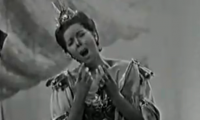
Roxy Music, “Ladytron” (1972)
Do you need to read any words about this? Just look. The singer’s face is exquisitely expressive, ridiculously expressive; whatever it expresses, your body knows it immediately. Try to grab that ephemeral “it” with the great pincers of your mind, cut it up to make defining words; it won’t be there any more.
I could talk talk talk myself to death. But I believe I would only waste my breath. On the page those words are nothing. But when he says them, they are a torrent of urgency, a comically defined voice riding a chaos of ephemera rolling in and out, the absurd voice that tries but cannot find a way, in a whirling world of masks and goof-ball fantasia.
Roxy Music, “Re-make/Re-model” (1972)
But sometimes it’s fun to read what people think about it, how they hear it. I used to write for a Zine (an actual pre-internet paper one) called Radio On. It was based on Top 40 lists; everyone who wrote, and they were very diverse, with only one or two critics, would say whatever they wanted about the songs, including random personal associations, what they were doing at work the first time they heard it, a conversation with their friend about it etc. In a way it had nothing to do with the music. But it had everything to do with music as a fluid phenomenon that becomes enmeshed in the DNA of people’s thoughts and feelings, and acts to express them.
In the first paragraph I said “the singer” instead of the singer’s name because Bryan Ferry, an embodiment of glam, and so an embodiment of the trendy, expresses with his face and voice something timeless. I don’t think I can say what it is. It might have something to do with longing and the ideal, and the absurdly shaped, unearthly quality of longing for the ideal. It might be the human way certain myriad effluvia came together in sound, sight and personality to express the experiential quality of a particular time before it passed into something else.
Fifty years from now Roxy Music may sound idiotic to all but the most arcane and culturally specialized ears. But anyone who sees the singer’s face, or the musician’s faces and bodies, will understand what they are saying, because people will still be saying it.
And it is very poignant, sometimes, for people to try to describe what their tiny piece of effluvia was at the moment it was all flying past: That day at work, their conversation with a friend.
Roxy Music, “Out of the Blue” (1974)
Five hundred years from now, Roxy Music might not sound like anything anyone would even call idiotic; it will be too far away to put a word on. The effluvia that helped form it, the thousands of bright tiny pieces that form social life, won’t mean anything anymore. The expression may still be identifiable, but vaguely, like a rubbed-away face on an ancient painting or a bodily gesture recognizable as, say, one of aggression towards or desire for something no longer visible. What was beautiful is now ugly, what seemed profound is trite. Do we know the difference?
Songs pass over our faces like gauze. Talk talk talk. Waste of breath. But sometimes, what pleasure.
Roxy Music, “For Your Pleasure” (2003)
– Mary Gaitskill